
Elliot's Creative Process
Every Painting Begins with Possibility
For many artists, an empty canvas can feel intimidating. For Elliot Denburg, it represents possibility. Before the first mark is made, he spends time looking at the canvas, taking in its proportions and considering where it might lead. There are no sketches to follow and no written notes describing what the finished painting should become.
The blank canvas is an invitation to discover something new. Rather than beginning with a fixed destination, Elliot begins with curiosity. From that first moment, the painting becomes a conversation between intuition, experience, and the surface in front of him..
Building the Painting
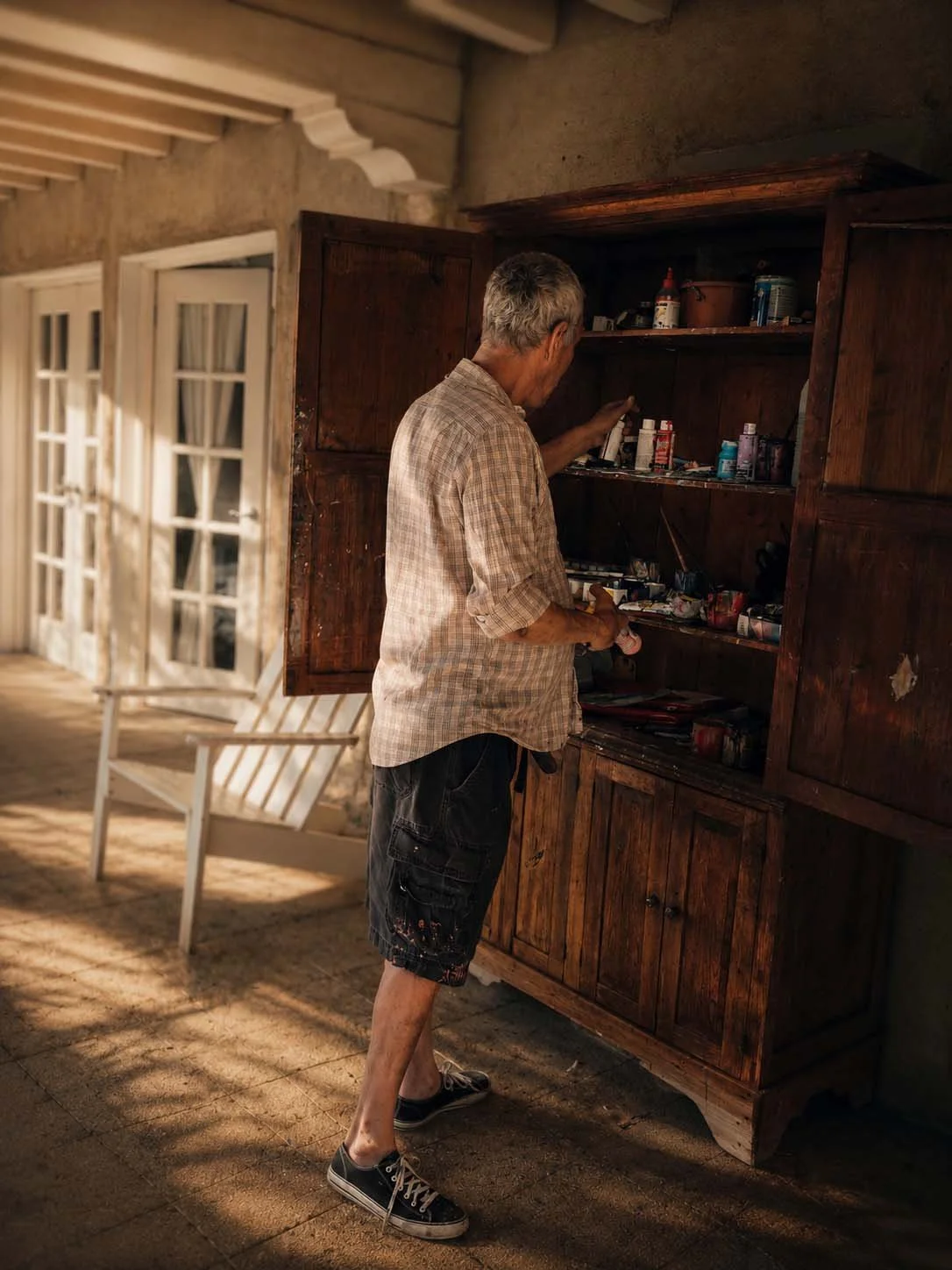
Every artist develops habits that become part of their process. One of Elliot's is where he begins.
Instead of starting in the center, he almost always starts at the edges of the canvas. As the borders begin to develop, they establish a rhythm that slowly guides the painting toward the middle. This approach allows the entire composition to grow together rather than forcing a focal point too early.
When working on triptychs, the process becomes even more complex. Three separate canvases must work as one, with every edge relating to another. Elliot often compares it to a game of three-dimensional chess, where each decision influences everything around it.
From there, the painting grows layer by layer. Dark values often establish the foundation with relatively few applications, while lighter passages are built gradually through many layers that create depth, light, and atmosphere.
As the surface develops, Elliot moves constantly across the canvas, responding to what each area needs. Pencil drawings, subtle illustrations, textures, and unexpected details are woven into the painting, inviting viewers to discover something new each time they return.
Harmony and Chaos
Elliot believes the strongest paintings exist somewhere between harmony and chaos.
Harmony creates balance and structure. Chaos introduces movement, energy, and surprise. Bringing those opposing forces together is never simple, but it is often where the most interesting work begins.
Sometimes that tension remains visible. Rather than trying to eliminate it, Elliot embraces it. A painting that feels too resolved can lose its energy, while a painting with a little uncertainty continues to invite exploration.
For Elliot, perfection has never been the goal. Creating a painting that feels alive is.
Experimentation Without Fear
Experimentation has shaped Elliot's work throughout his career.
New materials are not added for novelty. They are explored because they offer new ways of seeing. Gold leaf may be cut into pieces, rubbed into the paint, distressed, or layered until it becomes part of the painting rather than sitting on its surface. Resins, pigments, textured compounds, and other materials are approached with the same curiosity.
That curiosity extends beyond materials. Elliot is never afraid to change the painting itself. A section that took weeks or months to develop may be painted over if it opens the door to something stronger. What first appears to be a mistake often becomes the moment that gives the painting a completely new direction.
Every painting is an opportunity to learn. Every experiment has the potential to become part of the next one.
Time Is Another Layer
Not every painting is finished when the last brushstroke is applied.
Some remain in the studio for months or even years before they feel complete. Stepping away allows Elliot to return with fresh perspective, new ideas, and techniques that did not exist when the painting first began.
An older work may suddenly find its direction because of a newly discovered resin, a different material, or simply a new way of seeing. Nothing is rushed simply to reach a conclusion.
For Elliot Denburg, time is part of the creative process. Every painting follows its own path, and every finished work reflects years of experience, curiosity, and a willingness to keep discovering what is possible.